


How scores work.
A rigorous, two-level scoring system built on 85catalog feeds across 8 signal groups. Every sub-score is traceable to verifiable public data.
How composite scores work
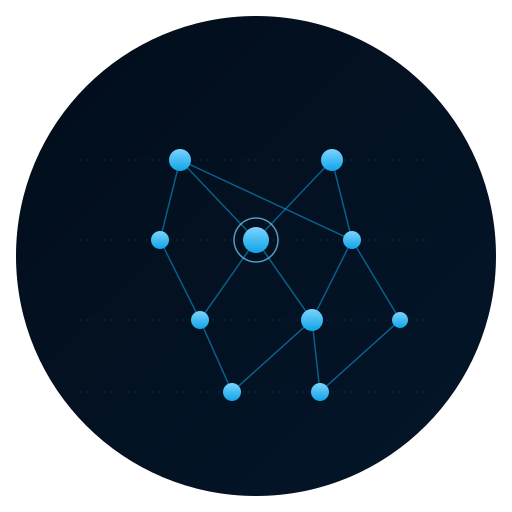
Every composite score is a weighted average of 8 independent signal groups, each scored 0–100. The groups cover commercial health, population trends, demographics, economic strength, development activity, infrastructure, safety, and amenity demand.
Each signal group is itself a weighted average of multiple sub-scores — each derived from a specific, verifiable data source. No single data point can dominate the final score.
Composite = Σ(group_score[i] × weight[i]) / Σ(weight[i])group_score = Σ(sub_score[j] × sub_weight[j]) / Σ(sub_weight[j])The 8 signal groups
Each group captures a distinct dimension of location quality. Weights are calibrated per scoring profile to emphasize factors relevant to each CRE use case.
Scroll horizontally to view all columns in this data table.
No black-box algorithms. No proprietary foot traffic panels. Every sub-score in Axiom Locus traces to a specific, verifiable source you can inspect.
Scoring profiles
Five built-in profiles adjust signal group weights for specific CRE use cases. The underlying data and sub-score calculations remain the same — only the group-level emphasis changes.
Scroll horizontally to view all columns in this data table.
Normalization
Each sub-score is normalized to 0–100 using ranges calibrated to US metro distributions. Linear scaling maps proportionally within range; logarithmic scaling is used for metrics with wide distributions (permit values, population density) to prevent outliers from compressing the useful range.
Fixed-range normalization keeps scores comparable across all metros. A 70 in Nashville means the same thing as a 70 in San Francisco.
Scroll horizontally to view all columns in this data table.
Confidence
Every score includes a confidence value (0.0–1.0):
confidence = sources_available / sources_possibleA confidence of 1.0 means all expected data sources returned data for this location. Lower confidence indicates some sources were unavailable — typically because the location is outside city-specific data coverage, or in a rural area with sparse government data.
Transparency
Every sub-score in Axiom Locus traces to a specific, verifiable data source. Our 85 catalog feeds include federal government datasets, municipal open data portals, and established commercial providers.
If a score does not match your on-the-ground experience, drill into the sub-scores and signal groups to understand why. No black-box algorithms, no proprietary foot traffic panels.